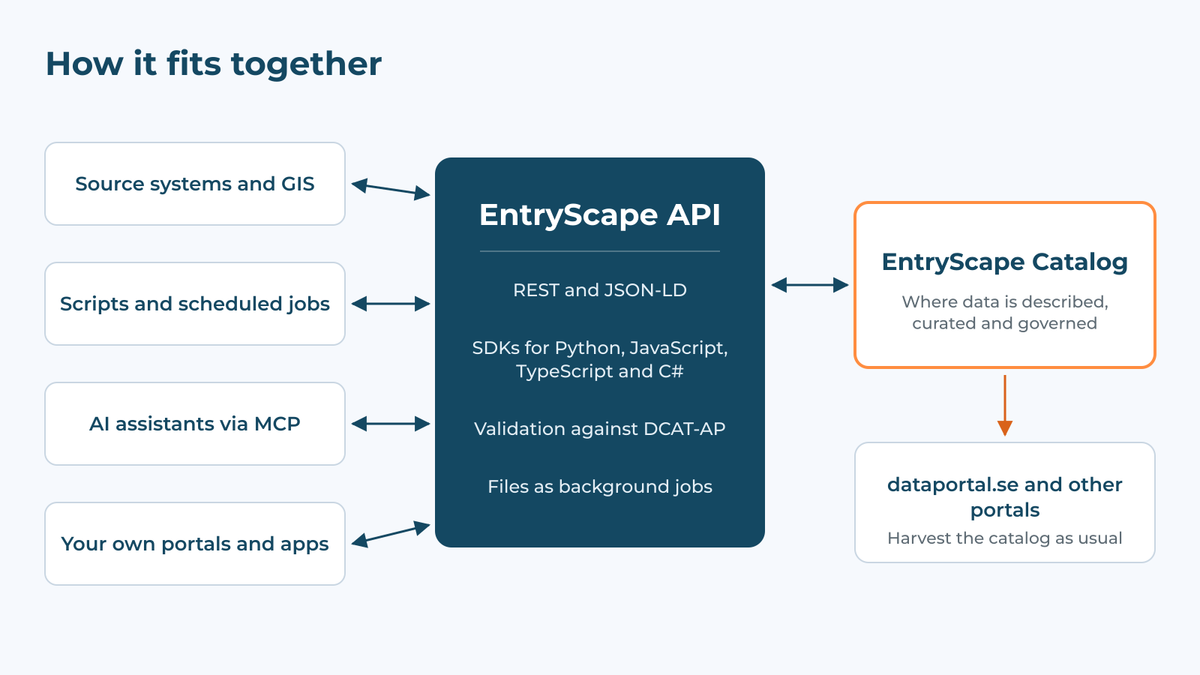
EntryScape API turns EntryScape Catalog into a building block. One REST interface lets your systems, scripts and AI assistants read, search, create, update and validate DCAT-AP metadata and upload data files, without anyone opening the web interface.
You already trust EntryScape Catalog to describe and publish your data. The new API lets you automate that work. Push datasets straight from your source systems, keep distributions fresh on a schedule, check DCAT-AP compliance before anything goes live, and build your own portals and apps on top of the catalog. With ready-made SDKs for Python, JavaScript, TypeScript and C#, and an MCP server for AI assistants, your team is productive in hours, not weeks.
The problem we solve
Manual catalog work does not scale. Organisations publishing open or shared data face the same friction:
- Metadata lives elsewhere. Datasets are described in GIS tools, data warehouses and registers, then retyped into the catalog.
- Files go stale. Someone must remember to upload this month's CSV, so published data lags reality.
- Compliance is checked too late. DCAT-AP errors surface after publishing, when a portal such as dataportal.se rejects or hides the entry.
- The catalog is a silo. Developers who want catalog content in their own sites or apps have no clean, documented way in.
- AI assistants can't see it. Staff increasingly work with AI tools that have no access to the organisation's data inventory.
What the API offers
The API covers the full lifecycle of catalogs, datasets, distributions and data services, as described in the EntryScape API documentation.
- Open read access. List public catalogs, datasets and distributions without logging in. Anyone can build on published data immediately.
- Search. Free-text search you can filter, which also shows how the results break down, for example by theme, publisher or format. Find the right dataset across large catalogs.
- Full RDF metadata. JSON-LD by default, Turtle and other RDF formats on request. Standards-based linked data, no lock-in.
- Create, update, delete. Write DCAT-AP entities as JSON-LD via token-authenticated calls, so metadata flows straight from source systems.
- DCAT-AP validation. Check an entity against the profile before writing, with a detailed error report. Catch compliance issues before they reach a portal.
- File management. Upload and replace distribution files as background jobs. The response is 202 with a job ID, and the job status shows its state and the new file's address.
- Auto-generated APIs stay current. If a distribution has an auto-generated API, uploading a new CSV file updates it.
- SDKs. Generated for Python, JavaScript, TypeScript and C#, with runnable examples.
- MCP server and Claude Code plugin. Connects AI assistants to the catalog, so you can ask, search and curate it in natural language.
- Hosted or self-hosted. Hosted at api.entryscape.com or on your own domain, for both cloud customers and on-premise installations.
The API replaces the deprecated Taskrunner. Uploads return 202 with a job ID, and errors are caught earlier: 413 for oversized files and 422 for the wrong kind of address, before the job is queued. See the migration guide.
Use cases with EntryScape Catalog
EntryScape Catalog remains the place where data is curated and governed. The API connects it to everything else.
Automated data refresh
A municipality publishes air quality, budget or traffic data monthly. A scheduled Python script replaces the distribution file via the API and follows the job to completion. The dataset on the portal is always current, with no manual upload.
Metadata straight from source systems
An agency's GIS platform or data warehouse already knows its datasets. An integration creates and updates DCAT-AP datasets in the catalog, so metadata is entered once, at the source. From the catalog it is then harvested onward to national portals like dataportal.se, just as today.

Quality gate before publishing
Every change runs through validation first. Errors come back as a detailed report, so a CI pipeline or data steward fixes them before the entry goes live. The result is fewer rejected entries and higher metadata quality.
Custom portals and apps
A region wants a themed data site for its own citizens. Front-end developers use the JavaScript and TypeScript SDK and the open read endpoints to list, search and facet datasets from the catalog, while curation stays in EntryScape.
A data API that follows the file
A department has an auto-generated API connected to its distribution. When a new CSV file is uploaded through the API, the data API is updated too, so developers and app builders always query the latest rows instead of downloading files.
AI-assisted catalog work
With the MCP server, staff ask an AI assistant "Which of our datasets lack a licence?" or "Draft a description for this new dataset". The assistant searches and reads the catalog and, with the right permissions, can propose or write updates.
Bulk migration and clean-up
An organisation moving from spreadsheets or a legacy catalog imports many datasets with a script, then uses search and validation to find and fix gaps at scale.
Enterprise integration in .NET
Organisations running Microsoft stacks use the C# SDK to connect case management or ERP systems, publishing reference data and registers to the catalog as part of existing workflows.
Value by audience
- Developers get documented REST, JSON-LD, SDKs in four languages, runnable examples and clear error codes. Integrate in an afternoon.
- Data owners and stewards get automated refresh, validation before publishing, bulk tools and AI assistance. Spend time on data quality, not data entry.
- CIOs and management get less manual work, higher DCAT-AP compliance, reuse of existing systems and no lock-in.
- Data users and app builders get open read access, search and data APIs that stay current. Fresh, trustworthy data you can build on.
Why EntryScape
Proven at national scale. EntryScape is the platform behind Sweden's national data portal, dataportal.se, and ngs.ehalsomyndigheten.se. The API opens that same platform to your own systems.
Built on open standards. DCAT-AP, RDF and linked data at the core, backed by MetaSolutions' expertise in semantic information modelling.
Get started
- Already using EntryScape Catalog? Try the open read endpoints on your own catalog today, then book a session with us to automate your first dataset.
- Using Taskrunner? Migrate now and gain SDKs and errors that are caught before the job runs.
- New to EntryScape? Let us show you a live demo: from CSV upload to a published, validated dataset and a working API in minutes.
Read more in the EntryScape API documentation and the EntryScape Catalog documentation, or contact us.